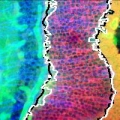
Accurate tracking of the microtubules is crucial for their dynamic instability analysis. We present a method for microtubule tracking that employs an arc-emission Hidden Markov Model (HMM) [1]. Proposed method is generic in terms of tracking general curvilinear structures/open-contour that can grow, shrink and undergo lateral motion from frame to frame.
The algorithm encodes the shape information of the structure in a spatially deformable trellis model that is iteratively modified to account for observations in subsequent frames. As the open contour is determined on the trellis of an HMM, a dynamic programming procedure reduces the computational complexity to linear in the length of the structure (or open-contour). Length changes of the structures are modeled by the addition of appropriate transient and absorbing states to the HMM.
Our results provide experimental evidence for the proposed algorithm's capability to track non-rigid curvilinear objects in challenging environments in terms of noise and clutter.
Output of the proposed algorithm (green) and the ground truth (red).
[1] M.E. Sargin, A. Altinok, K. Rose, B.S. Manjunath, "Deformable Trellis: Open Contour Tracking in Bio-Image Sequences", IEEE Int. Conf. on Acoustics, Speech and Signal Processing (ICASSP'08), April 2008


The Microtubule Research Group is trying to understand how the essential growing and shortening dynamics of microtubules are regulated, and how proper regulation leads to normal cell biology while aberrant regulation can lead to cellular disfunction in cancerous and neurodegenerative conditions such as Alzheimer's disease. In addition to light microscopy level resolution, attempts to understand the precise molecular mechanisms regulating microtubule dynamics are also being conducted using atomic force microscopy.